Your Horse Won't Pick Up Canter One Way?
Your Horse Won't Pick Up Canter One Way?
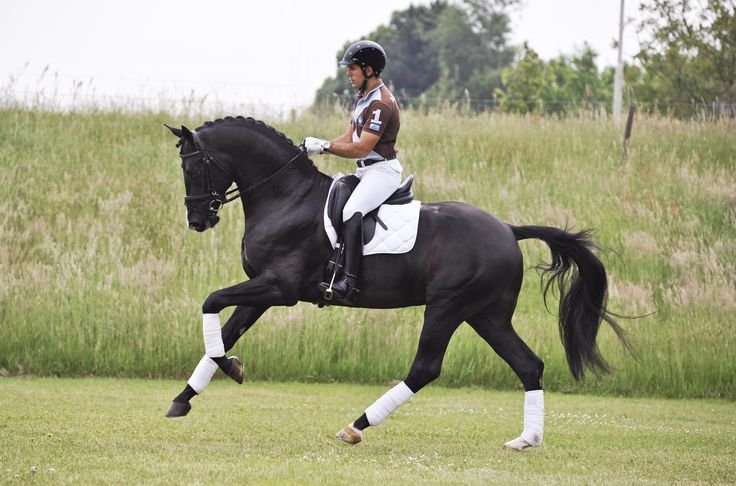
Does your horse find one canter lead much easier than the other?
Perhaps one transition feels effortless, while in the other direction they run through the trot, pick up the opposite lead, become disunited or need much more preparation.
Canter has a wonderful way of showing us asymmetry.
It asks the horse to coordinate the hindlimbs, pelvis, spine and trunk in a very particular sequence, while maintaining balance and preparing for a moment of suspension.
So when I see a difference between the two directions, I like to look at the whole horse.
And one of the places I may start is the sacrum.
Starting at the sacrum
The sacrum sits between the two ilia and has an important functional relationship with the lumbar spine.
Rather than thinking of it as a structure that simply moves forwards and backwards, osteopathic assessment considers its ability to move around different axes.
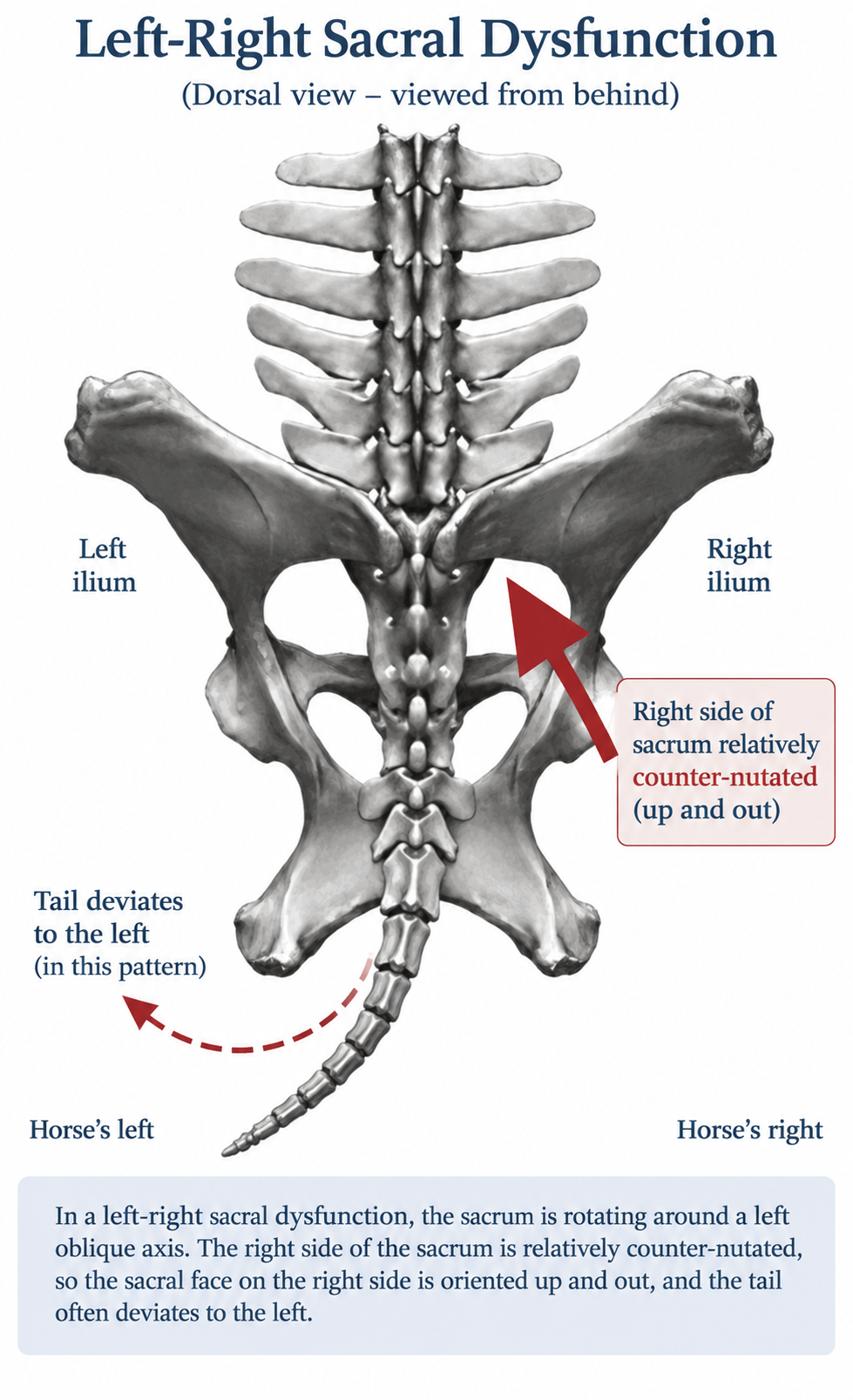
One pattern I might find, for example, is a left-right sacral dysfunction: In this pattern, the sacrum is moving around an oblique axis rather than simply moving forwards and backwards as one unit. The right side of the sacrum is relatively counter-nutated, creating an asymmetrical position through the sacroiliac region. In simple terms, one side of the sacrum is sitting and moving differently from the other.
From there, I can begin following how the horse is organising movement further forwards.
The lumbar spine is particularly interesting because it provides a functional link between the pelvis behind and the trunk in front.
And sitting right in the middle of that relationship is a structure most horse owners associate with something completely different.
The diaphragm.
The diaphragm is about much more than breathing
The diaphragm is our principal muscle of respiration, but its anatomical relationships make it particularly interesting when we're looking at movement through the horse.
At the back of the diaphragm are the crura, which extend into the lumbar region.
And they are asymmetrical.
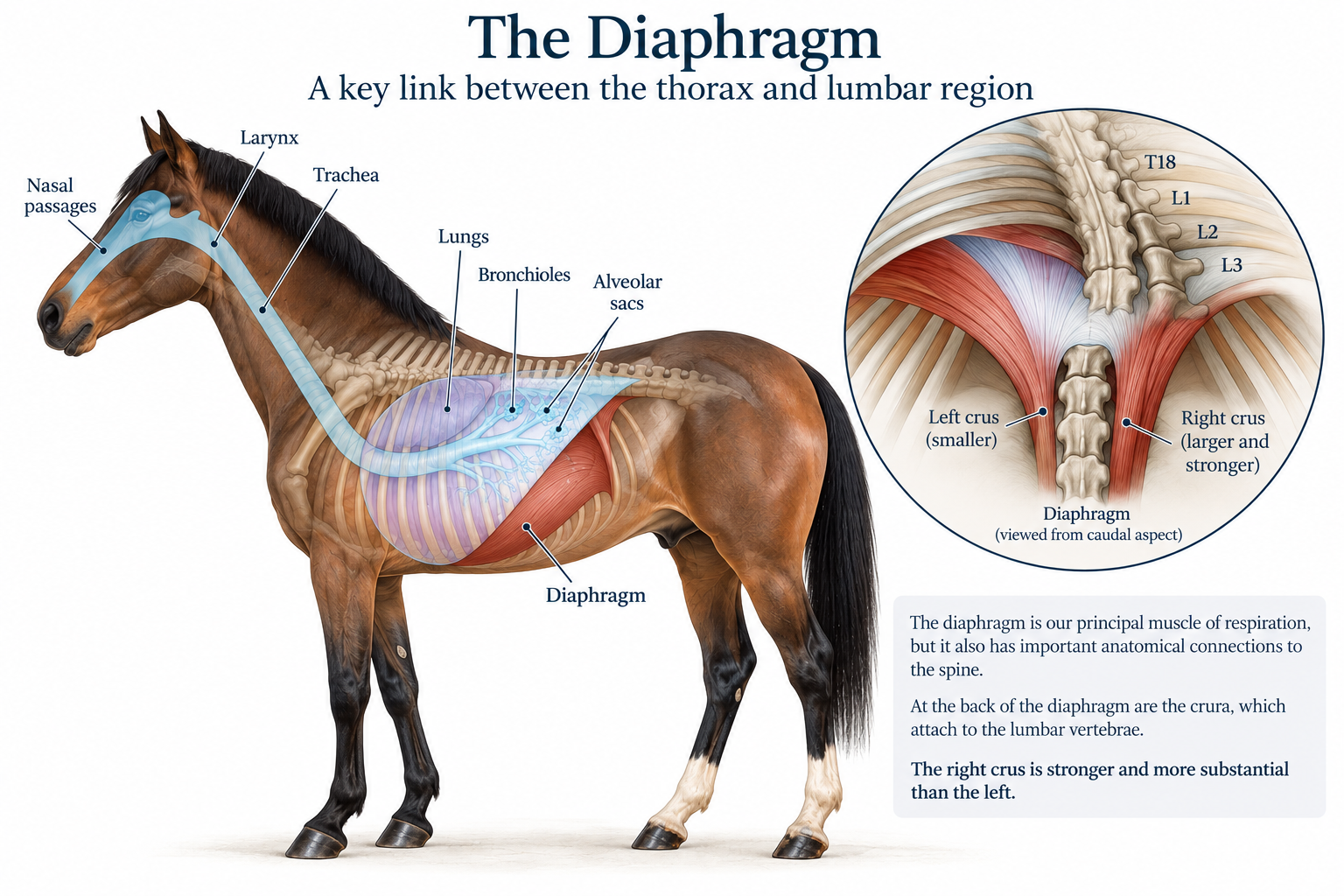
The right crus is stronger and more substantial than the left.
That immediately gives us something interesting to think about when we're looking at a horse already showing asymmetry through the pelvis and lumbar spine.
The diaphragm is moving with every breath while also contributing to the management of pressure and stability through the trunk.
The lumbar spine is moving.
The pelvis is moving.
The horse is transferring weight from one limb to another.
And during canter, all of those relationships have to be organised within a much more demanding movement pattern.
This is one of the reasons I enjoy looking beyond the area where we first notice a difficulty.
A canter transition gives us information about the canter, of course.
It can also give us an opportunity to look at how the whole horse is organising movement.
Following the horse
Once I've found an asymmetry, the interesting part is following it.
Does the pattern continue forwards?
What is happening through the diaphragm?
How is the rib cage moving?
How is the horse supporting and moving its trunk between the forelimbs?
And how does the horse continue to organise itself as we travel further forwards?
There can be several different pathways occurring within the same horse, which is why assessment becomes so interesting.
The visible difficulty may be the canter transition.
The story behind it can involve considerably more of the horse.
And that's where I'm going to leave this one, because it's also exactly where the subject becomes much bigger.
Something to watch with your own horse
Next time you watch your horse canter, don't only watch whether they pick up the correct lead.
Watch the transition itself.
Does the preparation look the same in both directions?
Does the trunk stay organised?
Does the horse change the position of the head or neck?
Does one transition require noticeably more speed?
And watch your horse in walk too.
Stand in front at a safe distance and watch the movement of the rib cage and trunk as the horse walks towards you.
Sometimes simply learning to observe the whole horse starts to change what we notice.
And that's a very useful place to begin.
If you'd like to explore this further...
This is one of the subjects we'll be exploring in my next live webinar, From Pelvis to Poll.
We'll follow these relationships much further through the horse, looking at the mechanical and myofascial connections alongside the sensory input and motor output involved in movement.
If you've already booked, I hope this has given you a little taste of where we're heading.
And if you'd like to join us, you're very welcome.
FROM PELVIS TO POLL
Thursday 10th September · 7pm UK
2-hour live webinar + Q&A
14-day replay included