Understanding the relationship between the hocks, stifles, hips and sacroiliac region.
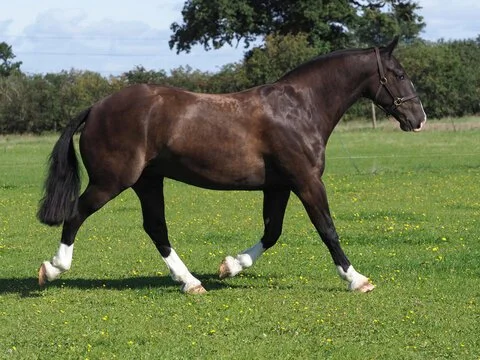
You're trotting around the arena or enjoying a hack when suddenly your horse's back end seems to disappear beneath you.
Almost as though they've stepped into a hole.
Sometimes it's one hindlimb. Sometimes it's the other. Occasionally, the entire hindquarter seems to drop.
And then, just as quickly, the horse carries on as though nothing has happened.
It's a distinctive sensation, and one I've encountered numerous times throughout my clinical work.
Recently, I came across a discussion in a horse owners' group where someone was describing exactly this experience.
What alarmed me was the number of responses suggesting that the solution was to ride the horse more strongly into the contact, apply more leg or generate greater impulsion.
But what if the horse is experiencing a problem with the very structures responsible for supporting and moving its hindquarters?
That's where understanding biomechanics becomes so important.
What is actually happening when the hindquarters drop?
During trot, the horse moves in diagonal pairs, with each hindlimb alternating between supporting the body and moving forwards in preparation for the next stride.
As the hoof contacts the ground, forces travel through the joints of the hindlimb and into the pelvis.
The horse must coordinate these forces while maintaining balance, supporting its bodyweight and preparing for the next phase of movement.
This requires a remarkable degree of coordination between the joints, muscles, tendons, ligaments and nervous system.
When a horse suddenly drops through one hindlimb, we are observing what appears to be a momentary disturbance in how that limb is supporting or controlling the body.
The rider's sensation doesn't necessarily prove that the limb has mechanically lost support. It might reflect a brief alteration in coordination, loading or movement.
There are several possible explanations, including pain, orthopaedic pathology and neurological conditions.
The important question is why that disturbance occurred.
And this brings us to four anatomical regions that deserve particular attention.
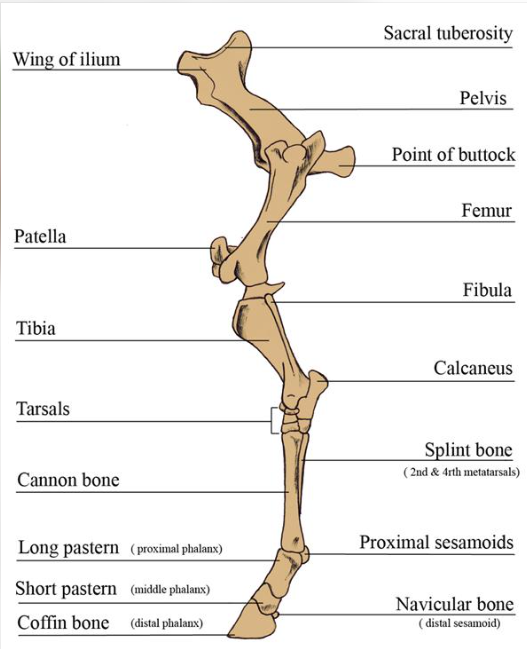
The hock: an important starting point
The hock is one of the first regions I consider when investigating this type of movement.
Its complex arrangement of joints allows it to accommodate considerable forces during locomotion.
Although we commonly describe the hock in terms of flexion and extension, its articular surfaces also create more subtle three-dimensional movement relationships.
These mechanics are important for the coordinated movement of the hindlimb.
Changes in joint health, discomfort or the way the horse loads the hock can influence how the limb functions during weight-bearing.
In my own clinical experience, I've encountered horses displaying this sudden dropping sensation where hock pathology was subsequently identified.
One particularly memorable horse demonstrated such dramatic changes in movement that the presentation initially appeared neurological.
Further veterinary investigation revealed osteochondritis dissecans (OCD) involving the hocks.
It was a striking reminder of how misleading a movement abnormality can appear without appropriate investigation.
The stifle: a close mechanical relationship with the hock
Moving further up the hindlimb, we reach the stifle.
The stifle is a complex joint involving the femur, tibia and patella, supported by an extensive arrangement of ligaments, menisci and surrounding musculature.
Its movement involves flexion and extension alongside smaller rotational components.
These movements must be coordinated as the horse accepts weight and moves through each stride.
An especially interesting feature of the equine hindlimb is the mechanical relationship between the stifle and hock.
Through the reciprocal apparatus, movement at these joints is closely linked.
This means that understanding the function of one joint also requires an appreciation of what is happening at the other.
Pain or pathology involving the stifle can affect how the horse loads and moves the hindlimb.
And changes in the way the limb functions can influence the mechanical demands experienced elsewhere.
This is why I consider the hock and stifle together when assessing hindlimb movement.
The hip: an often-overlooked part of the picture
The hip, or articulatio coxae, is another particularly interesting region.
It is a deep ball-and-socket joint connecting the femur to the pelvis.
Its position and surrounding musculature make it more challenging to assess than many of the more accessible joints of the limb.
Yet its role in movement is fundamental.
The hip contributes to how the hindlimb moves forwards and backwards, how the femur rotates and how forces are transferred into the pelvis.
Its function is closely related to the muscles of the hindquarters and lumbar region.
Changes in hip mobility, discomfort or the way the horse uses the surrounding musculature can influence the movement of the entire hindquarter.
Equally, changes in pelvic mechanics can affect the demands placed upon the hip.
I believe the hip deserves considerably more attention when we're trying to understand altered hindlimb movement.
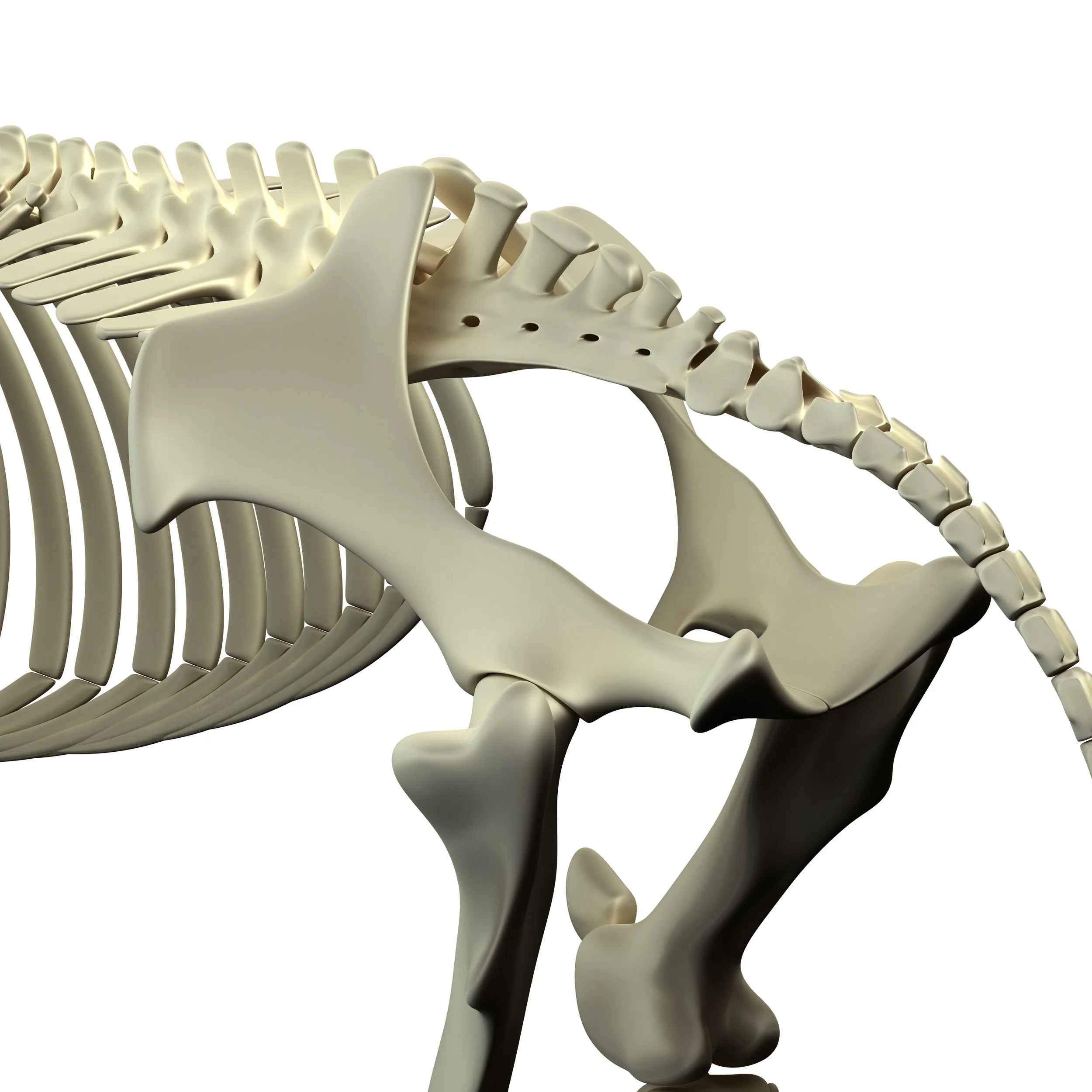
The sacroiliac region: where the hindlimbs connect with the spine
Finally, we reach the sacroiliac region.
The sacrum sits between the two ilia, forming an important connection between the pelvis and vertebral column.
The sacroiliac joints have relatively limited movement, but they play a significant role in transferring forces between the hindlimbs and the spine.
Every stride places changing demands upon the pelvis.
The sacrum, ilia, hips and lumbar region must work together to accommodate those forces.
When a horse experiences pain or altered function around this region, it may change how it loads its hindlimbs and organises movement through the pelvis.
In my clinical work, the sacroiliac region is another area I frequently investigate when horses present with unusual hindquarter movement.
However, changes in pelvic movement can also arise as a consequence of problems elsewhere in the hindlimb.
This is why identifying the primary source of a problem requires looking at the relationships between structures.
Why does it sometimes happen on different sides?
This is one of the most interesting aspects of the presentation.
Some horses repeatedly drop through the same hindlimb.
Others appear to alternate between sides.
And sometimes the rider feels as though the entire hindquarter has suddenly disappeared beneath them.
The explanation depends on the individual horse and the underlying problem.
Both hindlimbs contribute to supporting and propelling the body, and changes in how one limb functions can influence the demands placed upon the other.
A horse may also alter its movement to accommodate discomfort or difficulty with a particular phase of the stride.
These adjustments can make the presentation inconsistent or intermittent.
The side that visibly drops is therefore an important observation, but it doesn't necessarily identify where the original problem began.
Why can the horse carry on as though nothing happened?
This is something I find particularly interesting.
Owners sometimes assume that because their horse immediately returns to normal movement, the incident cannot be particularly significant.
But the forces acting upon the joints change continuously throughout locomotion.
Speed, direction, surface, fatigue and the individual horse's movement pattern can all influence how those forces are distributed.
A problem may become apparent only when a particular structure is challenged under certain conditions.
And horses can be remarkably effective at adapting their movement.
An intermittent problem still deserves investigation, particularly when it involves a sudden loss of hindlimb support.
So, is riding more strongly into the contact really the answer?
This brings us back to the discussion that prompted my original Facebook post.
There are many situations in training where improving balance, coordination and responsiveness to the rider's aids is entirely appropriate.
But when a horse repeatedly experiences a sudden dropping sensation through its hindquarters, we need to establish what is happening before increasing the demands placed upon it.
A veterinary assessment is an appropriate starting point, particularly where episodes are recurrent or there is concern about pain, instability or neurological involvement.
Further functional and biomechanical assessment can then contribute to understanding how the horse is moving and accommodating the problem.
Because the hocks, stifles, hips, pelvis and lumbar spine all contribute to hindlimb function, examining their relationships can provide valuable information.
Understanding the whole horse
Over more than two decades of working with horses, my interest in biomechanics has continued to grow.
The more closely we examine the relationships between different anatomical structures, the more we begin to appreciate just how complex movement really is.
A change in one region can influence the demands placed upon another.
And the movement we observe may be the consequence of a problem occurring somewhere else within that mechanical chain.
This is why I place so much importance on understanding the horse as a whole.
Before we ask more of the horse, we need to understand what its movement is telling us.
Want to explore equine biomechanics further?
I'll be sharing more educational articles exploring the relationships between different regions of the horse's body, alongside information about my upcoming webinars and courses.
If you'd like to continue learning with me, you can join my email list for updates.
Helen Thornton
Equine Osteopathy & PEMF